Addressing Employee Discipline Issues
What to Say When Situations Escalate:
Addressing Angry Employees and Other Stakeholders Using the S.T.A.I.R. Way
By Robert J. Vogelaar, Ed.D., SPHR, SHRM-SCP
Saint Louis University
Day-to-day challenges in an educational administrative role can be complex, especially when heightened emotions and conflicts arise. Disciplining employees, for example, can lead to a wave of angry responses. For many of us, having to deal with people in these situations has become the norm. Crises can and do take many forms (regardless of whether they flow from an employee discipline matter), but in each case one constant remains: We find ourselves in what I call reactive management mode. The more time we spend in this mode, the less time we have to plan, strategize, and solve the proactive needs that better serve our organizations and our learning environments.
Balancing the reactive demands crises require with our proactive priorities can, at times, be overwhelming. This is why being able to effectively and efficiently de-escalate angry people is important. I want to share with you a research-based strategy that has helped me and others do just that. This framework helps people handle angry situations with understanding, clarity, and confidence, so they can return to the work that matters most to them and their organizations.
I use the S.T.A.I.R. way because it better takes into account both the angry person’s perception of how responsible they think I am for the negative event and the extent to which they are offended by whatever it is they think I have done. From this, I am better equipped to choose the right words to repair how I am perceived (my image in their eyes) and to reduce the situation's volatility. After de-escalating, the situation returns to calm thinking, allowing everyone to get on the solution side of the issue that needs resolving. One disclaimer, however. There is a point when someone’s anger can escalate to where they become a danger to themselves or others, and in those cases communication is no longer the priority (Hayes, 2014). So, this approach does have a ceiling.
Why People Escalate
Before I begin, however, let's consider why people get angry in the first place. William Glasser (1985), in his book Control Theory, advanced the idea that anger often comes from the anxiety a person feels when their thoughts or beliefs are mismatched with the actions or behaviors of others. Because the brain naturally seeks harmony between the two, a gap that comes from unmet expectations triggers a threat response. When the gap gets too large, anxiety turns to anger. Glasser (1998), in a later book, Choice Theory, explained that this gap usually arises around basic needs going unmet. I share this because when we understand that anger is surfacing from an unmet needs gap, it helps us dissociate a person’s anger from a personal attack. When we can avoid taking someone’s anger personally, we are much less likely to become angry ourselves.
If we can avoid becoming angry when someone is verbally attacking us, we are better equipped to respond with calm thinking patterns rather than crisis thinking patterns. According to James and Gilliland (2020), calm thinking patterns are reasonable and logical. In contrast, crisis thinking patterns are unfocused, emotional, illogical, and concrete. When an angry person escalates, their thinking patterns need to draw from us responses that increase the likelihood of restoring them to calm thinking. Spending my time trying to win a debate will not accomplish that goal.
I understand, however, that this is easier said than done. Our instinct when someone is mad and blaming us is to defend ourselves. This is a natural response, especially when they have their facts all wrong. But defensiveness can do the opposite: It can make the conflict worse and erode trust even more. We need to understand how to unlearn reflexive, instinctual responses and reinforce, instead, how to communicate in ways that restore calm. That’s where using what I refer to as the S.T.A.I.R. Way can help.
The S.T.A.I.R. Way
S.T.A.I.R. stands for a Situationally Targeted Approach to Image Repair. It provides a framework that leans on image repair theory, attribution theory, and impression management to equip managers and leaders to do two things. First, it helps them properly diagnose the volatility of a situation. And, second, it points to communication strategies that are best to use to de-escalate any given situation. To keep this blog as practical as possible, I will try to explain the theories only enough to apply them practically.
Image Repair Theory
One of my former college professors, William Benoit (2024), identified the kinds of words people use to repair their image after a crisis. He claimed these words, if used correctly, can help to repair a damaged image following a negative event. His theory argues that when an incident occurs that affects how others perceive you, it damages your credibility with that audience. As you can imagine, regaining credibility is necessary to regain your persuasive ability. In other words, when someone is mad at you, no amount of skilled debating will assuage their anger. You just don’t have the credibility to win the argument. As a result, you have to say things that repair your image with that person first.
Attribution Theory
Timothy Coombs (2022), who authored the Situational Crisis Communication Theory, took strategies of image repair and associated them, using attribution theory, with how responsible a person is perceived to be by the offended audience for the negative event. Attribution theory says that we are never content with the effects in our lives. We want to understand the causes of the effects in our lives, so we engage in a cognitive journey to attribute responsibility to someone or something. These attributions can be internal to us (e.g., blaming myself) or external to us (e.g., blaming someone or something else). Once we believe we have correctly attributed responsibility, we cling to it as reality, even if we have misattributed it. According to Coombs, the more responsible a person is perceived to be, the more accommodating communication must be.
Said another way, if you want to use denial or blame shifting when accused of something, you can't be perceived as being responsible for the offensive act, or those words would backfire. Because perception is reality to the angry person, this is true even if you are being falsely accused. According to his theory, the more you are seen as responsible, the more accommodating your word choice must be. You would need to use phrases like, “I am so sorry you are feeling this way. Help me better understand what I’ve done so we can find a path forward.” Then, once calm is restored and you better understand the situation, you may be better received when you correct the record. In other words, restore calm first, and then try to win any debate worth winning later.
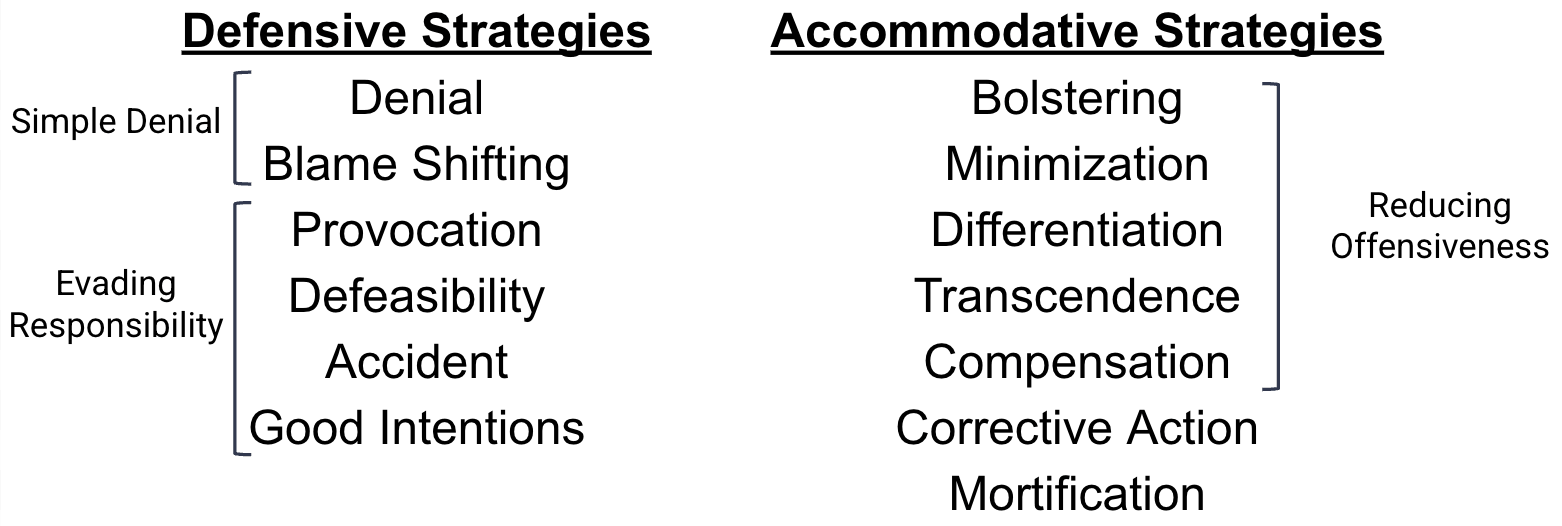
Below are Benoit’s (2024) strategies divided between defensive and accommodative strategy types using Coombs’ (2022) Situational Crisis Communication Theory (SCCT).

Impression Management Theory
The problem with relying too heavily on Coombs’ (2022) use of attribution theory is that not all conflict is created equal. Perceptions of responsibility alone are not enough to know when to shift from defensive talk to accommodative talk. To do this, it is important to understand the volatility of the situation before choosing what to say in response. For example, when someone is highly offended by something, even if they only minimally blame you, saying something like, “I don't understand why you’re yelling at me; I didn’t do it," may not help. Attribution theory suggests defensive words would be in bounds, but the volatility of the situation would indicate otherwise, sparking additional escalation, as those words could be perceived as uncaring and provocative.
When trying to determine how volatile a situation has gotten, impression management theory says there are two important things to consider: first is responsibility attribution, but the second is how offended the person is by the negative event (Schlenker, 1980). Both involve their perceptions. The first perception is how undesirable the negative event is, and the second is how responsible you are for it. For example, an employee who believes I am falsely accusing her of violating policy might be more upset than an employee who is not mad at me for disciplining him but is mad at the colleague for reporting it. In those moments, my job is to assess both perceptions and then choose how to communicate with the employees.
Below is Coombs’ (2022) defensive/accommodative continuum revised to account for the degree of offensiveness along with the attribution of responsibility.
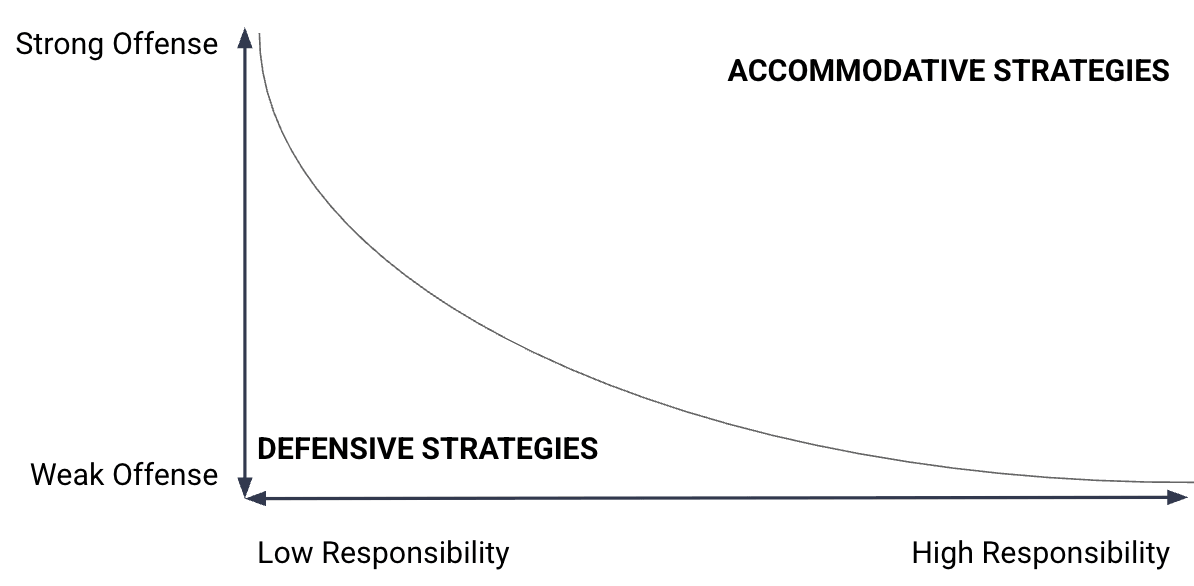
Notice how quickly one would need to abandon defensive strategies like denial, blame shifting, or other strategies designed to evade responsibility once the angry person is strongly offended by the negative act—even if they see you as not entirely responsible for what set them off. Their heightened level of offensiveness could easily lead them to see your very justifiable statements of denial as a provocative act (“I’m really mad!” “Well, don’t look at me. I didn’t do it!”). You would more effectively handle the angry person by first seeking to reduce the offensiveness before trying to set the record straight. Therefore, more accommodative words might be, "I am so sorry you are feeling this way. Please help me better understand the situation. I want to find the best path forward."
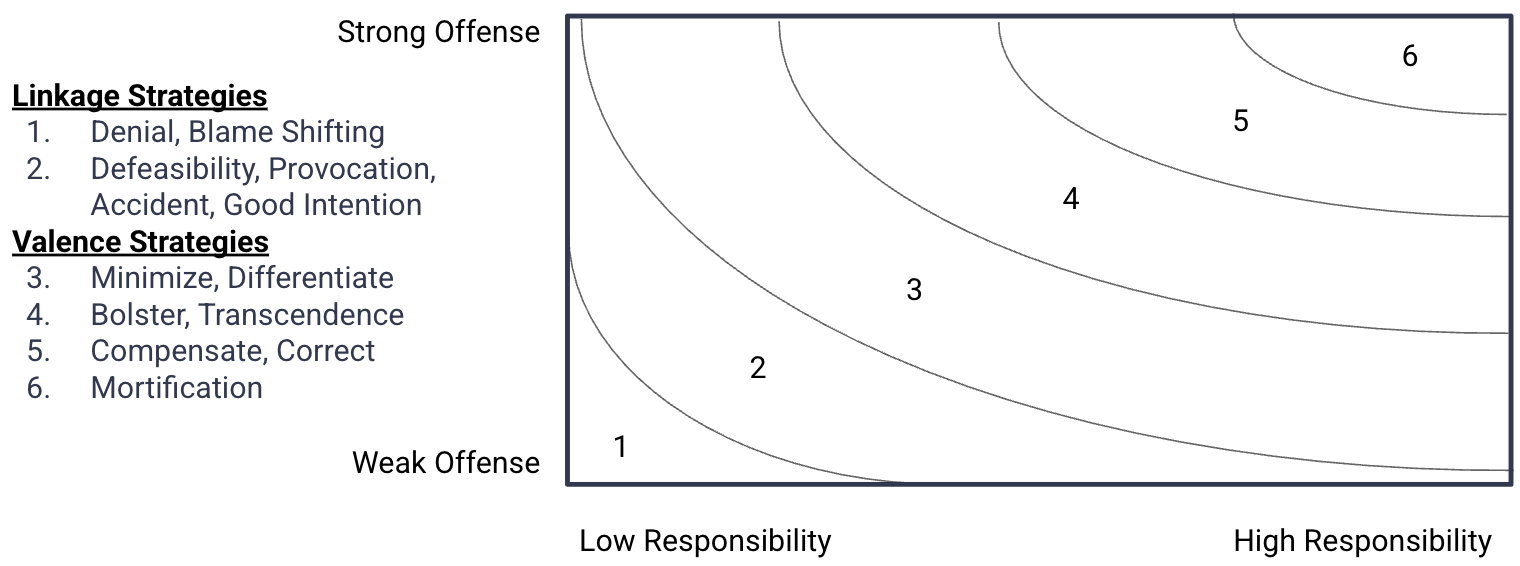
Below is the S.T.A.I.R. way that shows which of Benoit’s (2024) strategies are best to use given the dual perceptions of offensiveness and responsibility attribution. Look at this framework as if it is a bird’s eye view looking down on a staircase, where the 6th step is at the top of the staircase, where volatility is highest, and the 1st step is at the base, where everyone is calm.
As administrators we need to remember that conflict is not necessarily a bad thing. While it can be awkward, it can also be an opportunity to build relationships and demonstrate leadership. We can transform tension into growth when we are angry by coming to our people with empathy, with careful communication, and with a focus on resolution. So next time you are faced with an angry employee or other stakeholder, take a deep breath and remember that more often than not their anger is a reflection of some unmet need and not a personal attack on you.
I hope the S.T.A.I.R. way framework will help you better diagnose just how volatile a situation is and then guide you to the best strategy for responding with confidence and compassion. I invite you to try this framework throughout your day and notice how it changes your interactions. Effectively de-escalating conflict is not always easy, but it is one of the most important things we can do for our school communities to get us back on track with the very valuable proactive work of bettering the learning environment for all our students.
About the Author
Dr. Vogelaar has spent twenty years practicing school and district leadership in Missouri. He served as a school principal for six years and as the head of Human Resources for 14 years in his role as assistant superintendent. He retired in 2022 to join the faculty at Saint Louis University, teaching HR, finance, and operational leadership to the next generation of principals and superintendents. He has his doctorate in the superintendency and senior-level HR certifications from HRCI and SHRM. If you need any clarification about the S.T.A.I.R. way, please email Dr. Vogelaar at vogelaar@slu.edu.
References
Benoit, W. L. (2024). Accounts, excuses, and apologies: Image repair theory and research (3rd ed.). State University of New York Press.
Coombs, W. T. (2022). Ongoing crisis communication: Planning, managing, and responding (6th ed.). SAGE.
Glasser, W. (1985). Control theory: A new explanation of how we control our lives. Harper & Row.
Glasser, W. (1998). Choice theory: A new psychology of personal freedom. Harper Collins.
Hayes, A. (2014, April 27). The crisis cycle—concept to practice. The Mandt System. https://www.mandtsystem.com/2014/04/27/the-crisis-cycle-concept-to-practice
James, R. K., & Gilliland, B. E. (2020). Crisis intervention strategies (8th ed.). Cengage Learning.
Schlenker, B. R. (1980). Impression management: The self-concept, social identity, and interpersonal relations. Wadsworth.